
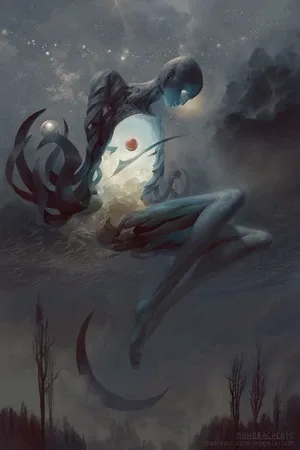
The human experience is not confined to waking reality. Within the folds of sleep, where consciousness slips its earthly bonds, lies a realm as vast and mysterious as the cosmos itself. In this realm—commonly called the astral plane—dreams are said to become more than neurological byproducts; they are journeys, projections of the soul, experiences beyond the body. But like any great voyage into the unknown, astral travel holds not only promise but peril. Among its shadowy paths dwell what some call astral nightmares—visions so intense, so viscerally symbolic, that they feel realer than waking life.
At its core, an astral nightmare is not just a bad dream. It is a confrontation with the self, the unconscious, or forces that seem external and alien. These nightmares may present as terrifying figures, endless voids, collapsing dimensions, or shadowy beings—entities many have encountered during sleep paralysis or deep meditation. Yet they may also manifest as symbolic echoes of trauma, guilt, or hidden desire. They ask: what are we truly afraid of when the ego is disarmed and the soul laid bare?
Psychologically, these nightmares may be explained by the mind’s attempt to process suppressed emotions or fears. Carl Jung’s concept of the “shadow”—the hidden, often darker part of the psyche—resonates powerfully here. In an astral nightmare, one may face their shadow directly, not as a metaphor, but as a living archetype. The fear this encounter invokes is existential. It forces the dreamer to confront aspects of themselves they deny: rage, grief, helplessness, or mortality itself.
From a mystical perspective, astral nightmares are sometimes viewed as tests or warnings. Esoteric traditions across cultures speak of the “lower astral” as a plane filled with illusion and chaos, inhabited by parasitic energies. To the untrained soul, these can appear as demons or monsters. But many mystics argue that these are projections—distorted mirrors of the self. The true danger lies not in the nightmare’s content, but in the dreamer’s reaction: fear, attachment, or egoic resistance.
In literature and art, these journeys into dark astral realms have inspired everything from Dante’s Inferno to Lovecraft’s cosmic horror. These stories echo a shared truth: that the dream world is not merely escape, but initiation. To journey through astral nightmares is to navigate the internal underworld. It is a rite of passage that demands courage, humility, and deep self-awareness.
Ultimately, astral nightmares remind us that the unknown exists not only in the stars but within. Whether one views them as metaphysical experiences or deep psychological processes, they serve an essential function: they reveal what is hidden. They challenge us to integrate our fears, heal our inner fractures, and return to waking life not broken, but reborn.



 Love
Love Astrologer
 Dreams
 Life Coach
 Medium
 Numerologist
 Palm Reader
 Paranormal
 Past Life
 Tarot Reader