
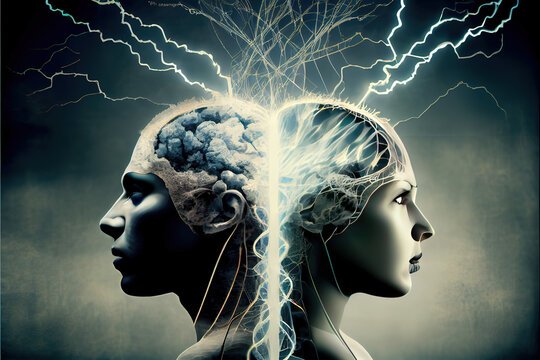
Telepathy, often referred to as “mind reading” or “mental communication,” is a phenomenon that has fascinated humanity for centuries. It suggests the ability to transmit thoughts, emotions, or information from one person’s mind to another’s without the use of conventional sensory channels. While telepathy remains a subject of debate and skepticism within the scientific community, it has captured the imagination of many and is a recurring theme in science fiction and paranormal lore. In this essay, we will explore the concept of telepathy, its history, scientific investigations, and the enduring mysteries that surround this phenomenon.
A Historical Perspective:
The concept of telepathy has roots in various cultures and belief systems throughout history. Ancient texts, myths, and folklore often contain references to individuals with telepathic abilities. It was a prevalent topic of interest in the late 19th and early 20th centuries during the heyday of spiritualism, with claims of psychic communication and mind-reading sessions.
Scientific Investigations:
Despite its long history and widespread interest, telepathy has faced significant skepticism from the scientific community. Many controlled experiments have been conducted to explore the possibility of telepathic communication, often using methods such as card guessing or remote viewing.
- Rhine’s Experiments: J.B. Rhine and his wife Louisa conducted pioneering research on extrasensory perception (ESP) and telepathy at Duke University in the 1930s. Their work involved experiments with card guessing to test telepathic abilities.
- Ganzfeld Experiments: In the 1970s, researchers developed the Ganzfeld technique, a controlled experiment involving sensory deprivation to test telepathic communication. Results from these experiments have been mixed and remain a subject of debate.
- Neuroscience and Brain-to-Brain Communication: Modern advancements in neuroscience have led to studies exploring brain-to-brain communication using technology. While these experiments have shown limited success in transmitting simple signals, the scope and implications of such research are still under investigation.
The Debate Surrounding Telepathy:
Telepathy continues to be a topic of debate within both scientific and paranormal communities. Skeptics argue that the evidence for telepathy is inconclusive, often attributing claimed telepathic experiences to coincidence, suggestion, or fraud. Critics maintain that there is no known mechanism by which telepathy could operate within the laws of physics and neuroscience.
On the other hand, proponents of telepathy argue that the existing scientific models may not yet fully explain the phenomenon. They believe that further exploration and open-minded research are necessary to understand the potential of human consciousness and the mind-to-mind connection.
Telepathy remains one of the enduring mysteries of human experience. While scientific investigations have produced mixed results and skepticism abounds, the allure of telepathy continues to captivate the human imagination. Whether viewed as a paranormal phenomenon or an unexplored aspect of human consciousness, telepathy represents a fascinating realm of inquiry that challenges our understanding of the mind, communication, and the boundaries of human potential. While the scientific community remains divided on the subject, the exploration of telepathy reminds us of the vast mysteries that still await our understanding within the enigmatic landscape of human consciousness.




 Love
Love Astrologer
 Dreams
 Life Coach
 Medium
 Numerologist
 Palm Reader
 Paranormal
 Past Life
 Tarot Reader