
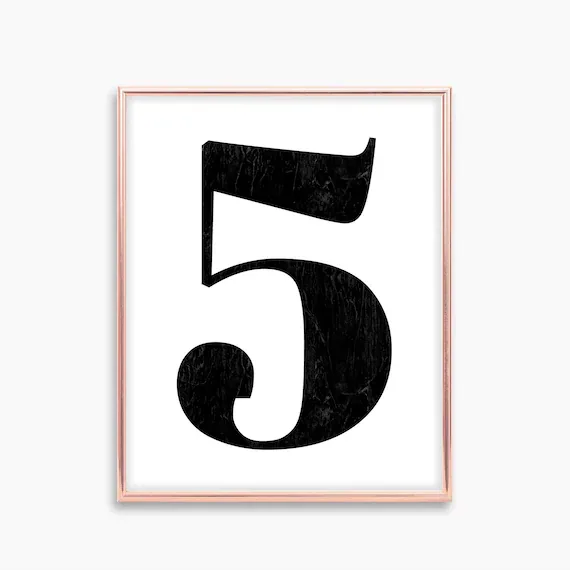
The number 5 holds deep symbolic meaning across cultures, philosophies, and spiritual traditions. It is often seen as a number of balance, freedom, and change representing the bridge between stability and motion. Positioned between 1 and 9, it stands at the center of single-digit numbers, symbolizing harmony though dynamic balance
In, numerology 5 is associated with adventure, curiousity and transformation. It embodies the human desire to explore and experience life to the fullest. People or events connected with this number are often marked by versatility and adaptability, embracing change as an opportunity for growth. The energy of 5 encourages breaking away from restrictions and seeking personal freedom.
Culturally, the number 5 appears in many symbolic systems. In ancient Greece, it represented the union of the first even and odd numbers (2 and 3), symbolizing the balance between male and female principles. In Chinese philosophy, the five elements wood, fire, earth, metal, and water form the foundation of natural balance and transformation. Similarly, many spiritual traditions recognize five senses, five fingers, and five elements, linking the number to human experience and the natural world.
Spiritually, 5 often signifies journey and evolution. It calls attention to the lessons that come through life’s changes and challenges. The number reminds us that true growth requires movement, risk, and the courage to adapt. In this sense, 5 represents the spirit of freedom that drives both personal and universal transformation.
In conclusion, the number 5 is a symbol of life in motion a reminder that balance is not found in stillness but in embracing the flow of change. Whether seen through numerology, philosophy, or spiritual tradition, 5 embodies the essence of adaptability, curiosity, and the endless pursuit of harmony between order and freedom.




 Love
Love Astrologer
 Dreams
 Life Coach
 Medium
 Numerologist
 Palm Reader
 Paranormal
 Past Life
 Tarot Reader