
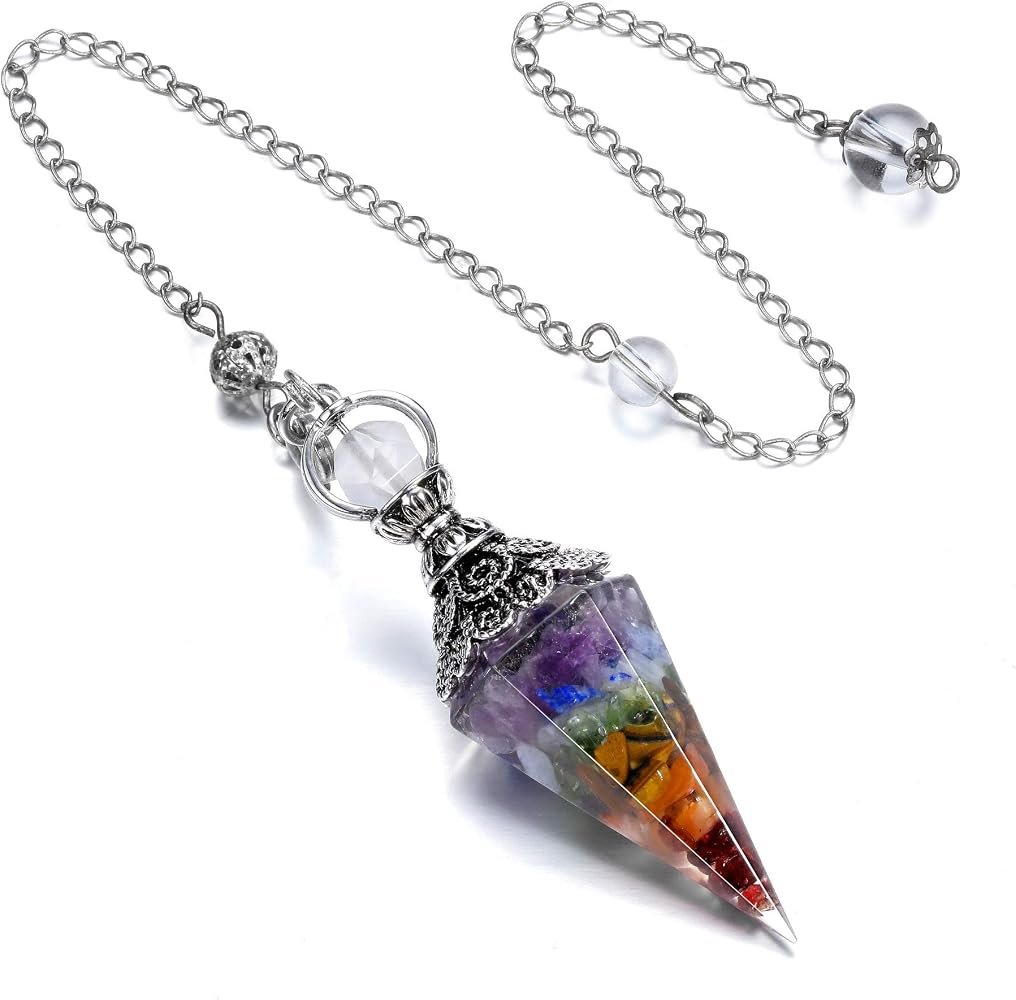
There is something wonderfully mysterious about a pendulum. It is such a simple little object, usually a crystal, gemstone, or metal weight hanging from a chain, yet people have been fascinated by its supposed ability to reveal hidden answers, uncover spiritual messages, and connect us with our intuition for centuries. It does not have flashing lights, a dramatic voice, or a crystal ball filled with swirling smoke. It simply hangs there, quietly waiting for someone to ask a question. Then, with the slightest movement, it begins to swing. Suddenly, something that looks like a pretty necklace becomes the center of a very interesting conversation with the unknown.
Pendulums have long been associated with divination, spiritual exploration, and the mysterious world of psychic abilities. Throughout history, people have used suspended objects in various forms of dowsing, sometimes searching for water, lost objects, or answers to questions they believed ordinary senses could not provide. Today, pendulums are especially popular among spiritual practitioners, psychics, energy healers, and curious beginners who want to explore their intuition. Some believe a pendulum can respond to spiritual energy, while others see it as a way to better understand their own subconscious thoughts. Either way, there is something undeniably intriguing about watching a tiny object move when you are barely aware of moving your hand.
One of the most fascinating things about pendulums is that they do not have to be expensive or elaborate. Some people prefer beautiful amethyst crystals, believing they encourage spiritual awareness and intuition. Others choose clear quartz because it symbolizes clarity and energetic balance. Rose quartz is often associated with love, emotional healing, and relationships, while black obsidian is traditionally connected with protection and grounding. Then there are people who use a simple metal pendant, a ring tied to a string, or even an old necklace they found buried in a jewelry box. According to many spiritual traditions, the power is not necessarily in how fancy the pendulum looks but in the intention and meaning the person brings to the practice. Apparently, the spiritual universe is not particularly impressed by expensive accessories.
Using a pendulum sounds almost ridiculously easy, which may be part of its charm. You hold the end of the chain between your fingers, allow the weighted object to hang freely, and wait until it becomes relatively still. Then you begin asking simple questions. Many practitioners start by establishing what movements will represent yes, no, or uncertainty. A pendulum might swing forward and backward for yes, side to side for no, and move in circles when the answer is unclear. However, these movements are not universal. Different people may notice different patterns, which is why many practitioners begin with questions they already know the answers to.
Imagine sitting quietly with your pendulum and asking, "Is my name Susan?" If your name is actually Barbara, you might expect the pendulum to move in whatever direction you have associated with no. Then you ask a question with a known yes answer and observe what happens. Once you have established your personal system, you can begin experimenting with other questions. Of course, asking whether your ex is still secretly obsessed with you might be tempting, but a swinging crystal is not a reliable substitute for an actual conversation. Sometimes the answer you really need is the one you have been avoiding.
This is where pendulums become especially interesting because there is a scientific explanation for why they move. It is called the ideomotor effect, a phenomenon in which unconscious muscle movements can influence an object without the person realizing it. Your hand may appear perfectly still, but tiny movements can cause the pendulum to swing. Expectations, emotions, and thoughts can influence these movements. This does not prove that pendulums communicate with spirits or predict the future, but it does help explain why the experience can feel so surprisingly personal. In fact, for some people, this makes pendulums even more fascinating because they may offer an unusual way to explore thoughts and feelings that are not immediately obvious.
Within psychic traditions, however, pendulums are often viewed through a much more mystical lens. Some practitioners believe the pendulum acts as a bridge between the conscious mind and spiritual awareness. Others believe it can help them focus their attention on subtle impressions, personal energy, or symbolic messages. There are even people who incorporate pendulums into meditation, chakra work, and spiritual cleansing rituals. Although these energetic abilities have not been scientifically established, the practices can hold personal meaning for those who enjoy spiritual exploration.
Pendulums are also popular in matters of the heart, which should surprise absolutely nobody. Give human beings a mysterious object that supposedly answers questions, and sooner or later somebody is going to ask whether their crush likes them back. Love, romance, friendships, and emotional uncertainty are among the most common subjects people bring to pendulum readings. Questions such as "Am I holding on to a relationship that no longer makes me happy?" or "Do I need to spend more time understanding my feelings?" can encourage self-reflection. The trick is remembering that a pendulum cannot reliably reveal another person's private thoughts, determine whether someone is cheating, or guarantee that a romantic relationship will succeed. Unfortunately, there is no crystal accessory that can make emotionally unavailable people suddenly develop communication skills.
Another fascinating part of pendulum practice involves the idea of energy. Some spiritual enthusiasts believe pendulums can detect disturbances in a room, identify energetic imbalances, or help determine whether a space needs cleansing. A practitioner might hold a pendulum over a crystal, a photograph, or an object believed to carry sentimental significance. Some use pendulum charts printed with words, numbers, colors, or symbols. The pendulum swings toward different sections, creating a symbolic reading that the practitioner interprets. Although these methods are not scientifically validated ways of detecting invisible energies, they can provide a structured ritual for meditation and contemplation.
Of course, no discussion about pendulums would be complete without mentioning the strange questions people sometimes ask them. Human curiosity has absolutely no limits. Someone might begin with a perfectly respectable question about personal growth and, ten minutes later, find themselves asking whether their neighbor is secretly a witch, whether their cat can see ghosts, or whether the mysterious noise in the hallway is a spirit trying to communicate. Pendulums have a way of bringing out both our spiritual curiosity and our slightly ridiculous imaginations. Perhaps that is part of the fun. Not every mysterious experience needs to become a dramatic supernatural investigation.
One important lesson for anyone experimenting with pendulums is to avoid becoming dependent on them. Spiritual tools should never replace personal responsibility, common sense, medical advice, financial judgment, or meaningful communication. Asking a pendulum whether you should wear the red dress or the black one might be an entertaining exercise. Asking it whether you should stop taking medication, invest your life savings, or leave your marriage is an entirely different matter. A healthy approach is to treat pendulum readings as symbolic exercises rather than unquestionable instructions from the universe.
There is also something rather beautiful about the patience involved in pendulum work. In a world where everyone wants instant answers, instant messages, and instant gratification, a pendulum encourages a person to sit quietly and focus. You cannot rush the experience without making the movement more difficult to interpret. You have to settle your thoughts, breathe, and pay attention. Sometimes that quiet moment of reflection may be more valuable than whatever direction the pendulum happens to swing.
For beginners, the best approach is curiosity without pressure. Find a pendulum that appeals to you, choose a comfortable place to sit, and experiment with simple questions. Notice whether your expectations influence the movements. Try asking questions with answers you already know, and observe whether the results are consistent. You might even keep a small journal of your experiences. Over time, you may discover that the most interesting part of using a pendulum is not whether it can predict something mysterious but what the process reveals about your own hopes, worries, and instincts.
And then there is the spiritual symbolism behind the pendulum itself. Think about it for a moment. A pendulum is constantly moving between different directions, searching for balance while responding to the smallest influence. In many ways, that is exactly what human beings do throughout life. We swing between certainty and doubt, love and fear, excitement and hesitation. We ask questions because we want reassurance that we are making the right decisions. We look for signs because sometimes the unknown feels a little less frightening when we believe something is guiding us.
Perhaps this is why pendulums continue to fascinate people even in a world filled with technology and scientific explanations. They represent the possibility that there is something meaningful to discover in the quiet spaces between our thoughts. Whether someone views a pendulum as a spiritual instrument, a psychological curiosity, or simply an entertaining tradition, its appeal lies in the mystery of asking a question and watching something move.
The next time you see a beautiful crystal pendulum hanging in a metaphysical shop, you might find yourself wondering what would happen if you held it in your hand. Would it swing in a circle? Would it move forward and backward? Would it seem to respond to a question you have been carrying around for months? Or would you discover that your own mind is far more mysterious than you ever imagined?
Maybe the real magic of a pendulum is not that it holds all the answers. Maybe it is that it reminds us how many questions we still have.
And if you happen to ask your pendulum whether you should buy another crystal, do not be surprised if it swings enthusiastically toward yes. After all, your subconscious might already have its credit card ready.
Because sometimes the greatest mystery is not what makes the pendulum swing, but why we are so fascinated by the answers we hope it will give us.



 Love
Love Astrologer
 Dreams
 Life Coach
 Medium
 Numerologist
 Palm Reader
 Paranormal
 Past Life
 Tarot Reader