
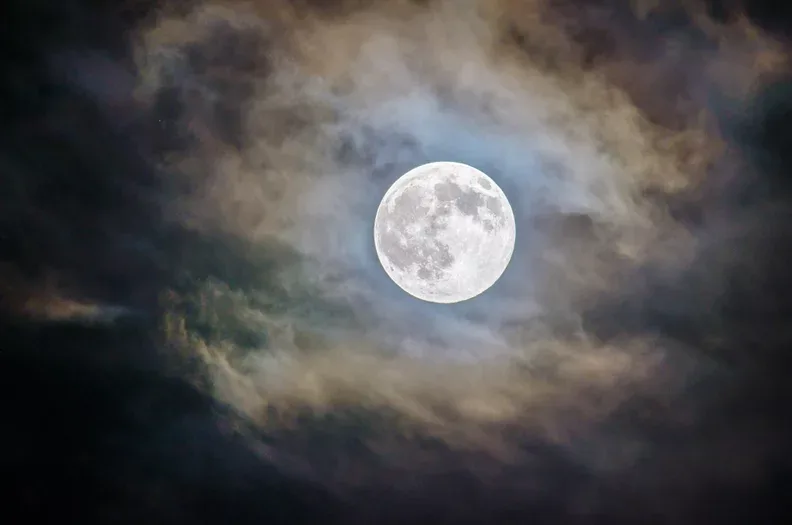
Spiritually, full moons are often seen as moments of culmination, illumination, and emotional release. They symbolize the peak of an energetic cycle a time when things that have been building internally, emotionally, or spiritually come to the surface for awareness.
In many spiritual traditions, the moon represents intuition, the subconscious, and inner emotions. When the moon is full, it is believed that these inner layers are “lit up,” meaning hidden feelings, realizations, or truths become harder to ignore. People often feel more emotionally sensitive, reflective, or energetically aware during this time, not because the moon controls emotions, but because it serves as a symbolic mirror of inner fullness.
One of the most common spiritual meanings of a full moon is release. Just as the lunar cycle reaches its peak brightness, it represents the completion of a cycle in one’s life. This is why full moons are spiritually associated with letting go of emotional baggage, outdated habits, negative thought patterns, or situations that no longer align with personal growth. It is less about gaining and more about clearing space.
Full moons are also linked to clarity. Spiritually, they are seen as moments when illusions fade and deeper truths become visible. Situations that once felt confusing may suddenly feel emotionally clear. People may experience strong intuition, vivid dreams, or sudden realizations about relationships, life direction, or personal healing.
Another spiritual interpretation is emotional amplification. The full moon is believed to heighten internal energy, which can intensify feelings both positive and negative. If someone is already overwhelmed, they may feel more emotionally reactive. If they are grounded, they may feel more intuitive and spiritually connected. In this sense, the full moon does not create emotions but magnifies what already exists beneath the surface.
Spiritually sensitive or intuitive individuals often use the full moon as a checkpoint for self-reflection. It becomes a time for journaling, meditation, energy cleansing, or shadow work. The idea is that the full moon provides a natural pause in the cycle of life, encouraging introspection rather than constant forward motion.
Full moons are also connected to manifestation cycles in spiritual belief systems. While new moons are associated with setting intentions and planting energetic seeds, full moons are believed to reveal the results of those intentions. They highlight what is working, what is misaligned, and what needs adjustment moving forward.
On a deeper symbolic level, the full moon represents wholeness. It is a reminder of emotional cycles, personal evolution, and the balance between light and shadow within oneself. Spiritually, it encourages acceptance of both growth and imperfection rather than chasing constant positivity.
Ultimately, the spiritual meaning of a full moon is not about superstition or external control. It is about awareness. It invites reflection, emotional honesty, and conscious release. Rather than being something that changes fate, the full moon is often viewed as a sacred energetic moment to pause, reconnect with intuition, and realign with one’s inner truth.




 Love
Love Astrologer
 Dreams
 Life Coach
 Medium
 Numerologist
 Palm Reader
 Paranormal
 Past Life
 Tarot Reader